– A widely discussed article of yours was recently published in *Rzeczpospolita*, which caused quite a stir in legal circles. You wrote that during this transitional period, as liberal-left circles in Europe struggle to survive and retain power, the principles of so-called liberal democracy are being undermined, and the role of lawyers is changing: they are increasingly becoming experts in the service of politicians seeking to maintain power.
– That’s true. Many lawyers no longer even try to hide this. Let’s consider what Donald Tusk, a representative of the liberal-progressive camp in Poland, said at a meeting with pro-government legal circles in September 2024: “We are in a phase of so-called ‘fighting democracy’; not everything will take place within the bounds of and based on the law, because the moment demands it.” Since December 2023, we have witnessed a veritable parade of actions that are openly contrary to the law, masked—in accordance with the principle of “apparent legality”—during Adam Bodnar’s tenure by effective PR campaigns and the involvement of many lawyers who, through their authority, affirmed the government’s compliance with the law, as evidenced by numerous opinions published in official communiqués from the Ministry of Justice.
– Including, for example, Prof. Sławomir Patyra, the candidate for Constitutional Tribunal judge currently nominated by the Sejm…
– Exactly. Prof. Patyra was one of the authors of the legal opinion that, in January 2024, was used by Minister Adam Bodnar and Donald Tusk to suspend National Prosecutor Dariusz Barski from his duties, even though the opinion’s argument completely contradicted the existing case law of the administrative courts, and the principles of legal interpretation—a fact later confirmed, among others, by the Constitutional Tribunal itself and the Supreme Court in its resolution No. I KZP 3/24. The issuance of this opinion coincided with Prof. Patyra’s appointment to the supervisory board of PGE. Interestingly, the Regional Court in Warsaw recently ordered the prosecutor’s office to conduct an investigation into the takeover of the National Prosecutor’s Office and to clarify the circumstances and mechanisms behind Dariusz Barski’s removal from his duties. This is particularly noteworthy because it coincided with Prof. Patyra’s election to the position of Constitutional Tribunal judge.
– We also recall the statements by Prof. Andrzej Zoll and Prof. Marek Safjan, who pointed out the possibility that the Speaker of the Sejm might fail to convene the National Assembly in order to prevent the swearing-in of the elected President, Karol Nawrocki.
– That’s true. Many lawyers who were previously regarded as authorities in the legal community are now supporting—or even encouraging—those currently in power to take actions that openly violate the Polish Constitution. As long as they could use their authority to push their views on issues such as the selection of judges for the National Council of the Judiciary, the interpretation of laws governing the structure of the common courts, or the scope of immunity for members of the Parliamentary Assembly of the Council of Europe, it was relatively safe for them, as it met the expectations of a specific political circle and their electorate. The problem arose when they began openly encouraging the deprivation of Poles’ right to elect their own president—in other words, when they struck at the very foundation of democracy. Many people then realized that things had gone too far.
– Prof. Wojciech Sadurski publicly encourages those in power to act “with a heavy hand,” for example, regarding the Constitutional Tribunal.
– Prof. Sadurski is a prime example of an academic who, after 2023, has—to put it colloquially—let all inhibitions go. As it happens, I’ve read a number of Prof. Sadurski’s articles, and he represents a school of thought that fits perfectly into a trend currently prevalent in Europe and the U.S.—any challenge to the dominance of liberal-progressive circles is elevated to the status of an attack on “democracy” or “the rule of law.” After all, this is precisely what the slogan of “restoring the rule of law” is meant to serve—which is nothing more than a renewed takeover of a number of public institutions that were previously staffed by people appointed by a government other than the one currently in power. And so, for example, the National Council of the Judiciary (KRS), recently elected on the basis of exactly the same regulations that have been in place since 2018, already meets all democratic standards, whereas the previous two terms did not.
– Isn’t this a phenomenon unique to Poland?
– Of course not. In the U.S., there is a massive debate in legal scholarship among lawyers, for example, regarding the scope of power of a president who holds the strongest popular mandate. A number of legal scholars associated with an intellectual group promoting the thesis of a “postliberal order” point out that judges appointed by Democratic presidents—or by those who clearly sympathize with them—are blocking President Trump’s legislative acts for political purposes, for example, on immigration issues. There is widespread talk of so-called “juristocracy” as a pathological phenomenon, in which lawyers—who are neither elected in democratic elections nor subject to recall—block legal changes expected by the public. This fuels public frustration. We are observing the United Kingdom, where courts impose draconian penalties for social media posts, even though they tend to be surprisingly lenient in cases involving crimes committed by immigrants. There is a growing disconnect between the public’s sense of justice and the justice as perceived by lawyers. This does not bode well.
– Why?
– By definition, the law is a system that should protect the values of the political community and regulate social relations. Eugen Ehrlich, one of the most prominent representatives of the sociological school of law, recognized as early as the turn of the 19th and 20th centuries that the law is a derivative of the institutions functioning within a living social organism, and not the other way around. It is a given community—influenced by historical experiences, cultural phenomena, or religion—that determines what is socially just and what values the law should protect. As a rule, the opposite is not true. This is perfectly illustrated by the problems associated with immigration into Europe from other cultures. In the United Kingdom, the rise in poll numbers for sovereignty-oriented parties, such as the Reform Party or the even more radical Restore Britain, is linked to their open challenge of the incomprehensible rulings of British courts, which severely punish British citizens for anti-immigrant posts on the Internet, while being exceptionally lenient toward perpetrators of the most heinous crimes committed by immigrants. The courts have ceased to be an authority that administers justice and have become a political authority safeguarding a specific ideological and political direction—the “armed wing” of liberal-left political forces. This is characteristic of a transitional period in which the existing establishment is losing power.
– This is also evident, for example, in the case law of the European Court of Human Rights.
– Oh, yes. We wrote about this with Prof. Ireneusz Cezary Kamiński some time ago. Prof. Kamiński is an expert at the HFPC and a former ad hoc judge at the Strasbourg Court, who openly criticizes the absurd policies of that international court. The ECHR’s case law—which, under the guise of protecting human rights, shields from deportation, among others, illegal immigrants convicted of serious crimes or terrorism—has sparked a backlash from a significant number of Council of Europe member states. In May 2025, for the first time, representatives of European countries, including Italy and Denmark, openly called on the Strasbourg Court to change its case law regarding migration issues. In the United Kingdom, the crisis of confidence in the Strasbourg Court is so acute that an overwhelming majority of Britons support withdrawing from the 1950 Rome Convention. Here in Poland, the Strasbourg Court’s involvement in Poland’s internal affairs (e.g., regarding the Constitutional Tribunal) is similarly very evident and is no longer so much a source of opposition as it is a gesture of little legal or political significance. There has been a sort of inflation in the case law of the European Court of Human Rights.
– So, is a change coming to legal scholarship?
– I think this is perfectly clear. The liberal human rights system we’ve known for decades in Europe is creaking and threatens to collapse. Something new will emerge in legal scholarship. I regularly read what liberal-progressive lawyers write in the foreign press. Frequent contributors from Poland include Adam Bodnar, Marek Safjan, Wojciech Sadurski, and, for example, former Constitutional Tribunal judge Mirosław Wyrzykowski. In the *Verfassungsblog*—published and supported by the German government—one can find a number of articles that reflect the discussion among legal scholars on how to halt the “populists’” march toward power and—as we’ve seen before—defend “liberal democracy.” It was in the pages of this publication that former European Court of Human Rights (ECHR) judge András Sajó—employed at the George Soros-funded Central European University—wrote in 2023 about the need to implement so-called “combative rule of law” —the authorities, in order to safeguard or restore the rule of law, may employ methods that deviate from the letter of the law. Sajó is a guru for lawyers supporting Donald Tusk’s government and the mentor of Adam Bodnar, who even appointed him as the Ombudsman. Last year, articles appeared that effectively affirmed the first instance of censorship in a German election campaign—two AfD candidates were barred from local elections before registration due to their stance on the issue of re-emigration. These decisions were upheld by the administrative courts of the western states.
– But surely not all lawyers are supporters of so-called “militant” democracy or the rule of law?
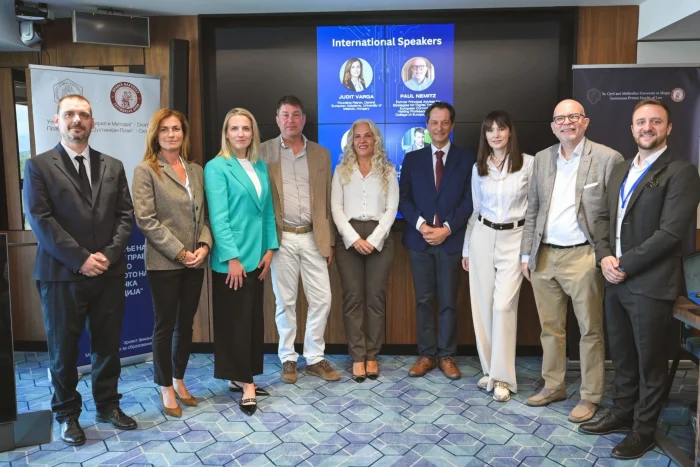
– Of course not. Many not only view the actions of their colleagues—who have been drawn into the current political dispute—critically, but even openly criticize them. I see an increasing involvement of lawyers who clearly recognize the European Union’s authorities’ growing tendency to exceed the limits set by the treaties and encroach upon the constitutional sphere and areas reserved for nation-states. I believe that the central axis of the dispute among lawyers in the coming years will be precisely the issue of sovereignty, as the outgoing liberal-left establishment seeks to shift the burden of all decision-making in Europe to the EU level. This is clearly evident in the increasingly bold rulings of the Court of Justice of the European Union (CJEU). There is already a network of legal scholars in Europe who are studying this phenomenon and conducting a critical analysis of such developments. Since last year, I have had the honor of being a member of an international research network of Central European professors at the University of Miskolc in Hungary. As part of the Central European Academy, scholars from our part of Europe are working on joint research and publications in the field of contemporary political and legal phenomena. This is a unique group of specialists—academics, judges, prosecutors, and attorneys—who publish monographs, articles, and conference proceedings on current trends and phenomena in European law. This year, under the guidance of UKSW Professor Marcin Wielec, we conducted very detailed research on the liability of public authorities for violations of the law, a topic that is particularly relevant in light of current events in Poland. This is also of interest to, for example, Hungarian lawyers, as the political program of the new government in Budapest clearly resembles that of Donald Tusk’s government regarding the application of the law “as we understand it.” The results of this research, presented in a format more accessible to non-lawyers, can be read on the professors’ blog at: https://www.ceaclaw.org/blog. I warmly encourage you to check it out.
https://dorzeczy.pl/opinie/911383/mec-lewandowski-sady-staly-sie-wladza-polityczna.html