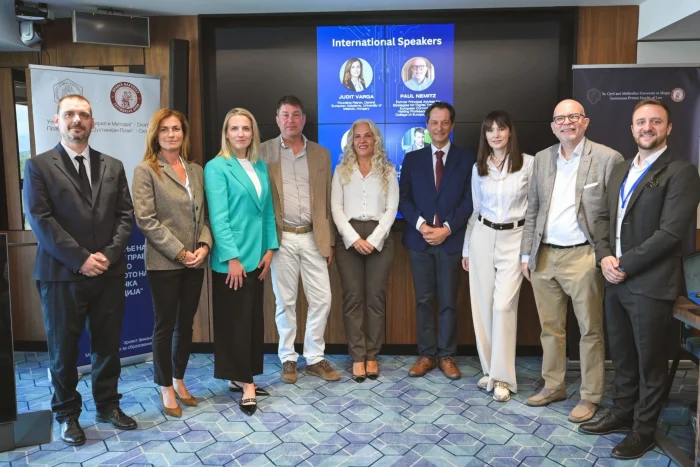
25 April 2025, Palacky University in Olomouc
Content of the online speech (lecture):
The online speech was focused on the issue of the pre-accession assistance to EU candidate countries, especially on the situation and the support for Balkan countries and Ukraine.
The EU enlargement process is a very demanding process, requiring candidate countries to meet a number of conditions. During the accession process, a candidate country demonstrates that it meets the accession criteria and that it is able to assume the rights and obligations of EU membership. Depending on the specific situation, a candidate country must therefore often undergo profound reforms to reflect EU law (the acquis) in its legal system and practice. In order for candidate countries to meet the conditions for membership, a strong focus on fundamental reforms in the rule of law, the functioning of democratic institutions and public administration and the market economy, as well as reform and alignment of the national legal order with EU law, is required. For candidate countries, meeting these requirements often entails major institutional and legislative changes. These changes are of course demanding in terms of time, finance and personnel, professional and technical resources, and their support within the candidate country itself (political representation and citizens themselves) is also important. It is therefore quite obvious that such steps, in order to be successful and to lead in real terms to the country’s accession to the EU, also require „external” assistance and support during the accession process. This support is provided by the EU to the candidate countries, and a distinction can be made between legal support and financial and technical support. The EU uses different instruments for this assistance and support, which will be discussed in more detail below.
The European Union currently provides financial and technical assistance to candidate countries through a key mechanism, which in this respect is undoubtedly the Instrument for Pre-Accession Assistance III (IPA III). This instrument has been updated several times since its introduction in 2007 and is now in its third generation. IPA III was adopted by a Regulation of the European Parliament and of the Council on 15 September 2021. The instrument applies retroactively from 1 January 2021 until 2027. It is a key financial instrument of the European Union and its Member States to support third countries at different stages of the EU accession process. Its main purpose is to support beneficiaries in implementing the political, institutional, legal, administrative, social and economic reforms necessary to align with EU values and to progressively align with EU rules, standards, policies and practices with a view to future membership. The current IPA III has a budget of more than €14 billion for the period 2021-2027.
In addition to the IPA III programme, candidate countries can benefit from other funds and through other EU instruments to finance specific areas of development or cooperation. Often these are instruments that benefit both member and candidate countries (i.e. they are not exclusively aimed at supporting candidate countries). Each of these instruments applies to support in a different area and under different conditions. There are some examples: the Neighbourhood, Development and International Cooperation Instrument – Global Europe (NDICI), the EU Humanitarian Aid Instrument, the EU Civil Protection Mechanism and rescueEU, Horizon Europe, the Erasmus+ programme, Interreg, the LIFE Programme etc.
Ukraine, unlike the other candidate countries, is in a much more difficult situation as it faces a military attack from Russia from February 2022. The EU’s assistance to Ukraine is therefore specific in that it is not just about supporting the country’s preparation for EU accession, but about supporting Ukraine against this war of aggression. Assistance to Ukraine is therefore of a diverse nature, not only financial and legal, as mentioned above, but also military and humanitarian. On 20 June 2023, the Commission proposed a new Ukraine Facility to support Ukraine’s recovery, reconstruction, and modernization as well as foster Ukraine’s EU accession path. It entered into force on 1 March 2024. The Ukraine Facility will provide up to €50 billion in grants and loans for the period 2024-2027 to support Ukraine’s efforts to sustain macro-financial stability, promote short-term recovery as well as rebuild and modernise the country whilst implementing key reforms on its EU accession path.
The New Ukraine Facility is made up of three pillars. The first pillar consists of support through the Ukraine Plan. This pillar entails the provision of financial assistance to Ukraine, totalling €38.27 billion. Comprising both grants (€5.27 billion) and loans (€33 billion), this support aims at addressing the financial needs of the Ukrainian state to maintain macro-financial stability while support reforms and investments aimed at the recovery, reconstruction and modernisation of Ukraine. The support is conditional upon fulfilment of requirements linked to essentials such as macro-financial stability, budget oversight, and public financial management, sectoral and structural reforms and investments (necessary for the EU accession). A precondition for the support to Ukraine under the Facility is that Ukraine continues to uphold and respect effective democratic mechanisms, including a multi-party parliamentary system and the rule of law, and to guarantee respect for human rights, including the rights of persons belonging to minorities. Pillar II consists of a ‘Ukraine investment framework’ designed to attract and mobilise public and private investments for Ukraine’s recovery and reconstruction, in support of the Ukraine Plan’s implementation. In terms of Ukraine’s preparation for EU accession, the biggest role is played by Pillar III: Union accession assistance and related support measures. This pillar, amounting to €4.76 billion, focuses on providing technical assistance and support measures to facilitate Ukraine’s alignment with EU laws and regulations.
The EU has also long sought to provide special support programmes exclusively for candidate countries from the Balkans. These instruments focus on key reform areas, supporting economic development, building the rule of law, as well as promoting mutual reconciliation and regional cooperation. Given the limited space for this lecture, our focus will be on the most recent key EU support in relation to the Balkan candidate countries – the Growth Plan for the Western Balkans and the Reform and Growth Facility for the Western Balkans.
The Reform and Growth Facility for the Western Balkans is the financial instrument supporting the Growth Plan for the Western Balkans (adopted in November 2023). The Growth Plan is a new instrument to accelerate the Western Balkans’ preparations for EU membership by bringing forward some of its benefits ahead of accession with direct impact for citizens and businesses. This in turn should significantly accelerate the speed of the enlargement process and the growth of their economies. The Reform and Growth Facility for the Western Balkans is complementary to EU assistance already provided through the Instrument for Pre-accession Assistance (IPA III). The facility has a financial envelope of €6 billion, including €2 billion in grants and €4 billion in highly concessional loans. At least half of the total amount (grants and loans) will go towards investments through the Western Balkans Investment Framework (WBIF). The remaining amount of loans will be provided on the basis of socio-economic reforms.
The Growth Plan for the Western Balkans was adopted by the Commission on 8 November 2023 and aims to (1) integrate the Western Balkan partners into the EU single market, (2) deepen regional economic cooperation, (3) deepen EU-related reforms and (4) increase pre-accession funding with a view to accelerating the socio-economic convergence of the Western Balkans towards the EU. Economic convergence is an essential element in bringing the Western Balkan countries closer to the EU. Indeed, lack of convergence is a major problem in the Western Balkans region; it is currently at around 35% of the EU average. The Growth Plan has the potential to double the size of the Western Balkan economies over the next decade. To support this process, the Reform and Growth Facility for the Western Balkans, mentioned above, was adopted for the period 2024-2027. The Reform and Growth Facility Regulation entered into force on 25 May 2024.
The Plan is based on four pillars. The first pillar is focused on enhancing economic integration with the European Union’s single market. Integration with the EU’s single market has been the main driver of economic growth for all countries that joined the EU. The offer to the Western Balkans included seven priority actions for integration into the EU’s single market (Free movement of goods; Free movement of services and workers; Access to the Single Euro Payments Area; Facilitation of Road transport; Integration and de-carbonisation of Energy markets; Digital Single Market; Integration into industrial supply chain). Boosting economic integration within the Western Balkans through the Common Regional Market (CRM), based on EU rules and standards, represents the second pillar. The CRM is vital to overcome small fragmented markets, make businesses competitive, attract investors and retain workers. The third pillar is based on accelerating fundamental reforms, supporting the Western Balkans’ path towards EU membership, improving sustainable economic growth including through attracting foreign investments and strengthening regional stability. The last pillar is based on supporting convergence through increased financial assistance.
In October 2024, the Commission approved the reform programmes of Albania, Kosovo, Montenegro, North Macedonia and Serbia, following a positive opinion of EU Member States. In their reform programmes, the five Western Balkan governments have committed to socio-economic and fundamental reforms that will accelerate growth and convergence with the EU in the framework of the 2024-2027. The reform programmes focus on reforms in the priority areas of rule of law and other fundamentals, governance, digital and green transformation, human capital development and the business environment. In addition, each beneficiary has proposed a list of indicative investments to be financed under the Facility. This step was necessary to enable disbursements. Payments will be made twice a year until 2027 on the basis of requests submitted by the Western Balkan partners and after verification of the conditions set by the Commission. These conditions include, for example, the promotion of democratic mechanisms, the rule of law and respect for human rights (a special condition for Serbia and Kosovo, which must engage constructively in the normalisation of their relations, including the implementation of all dialogue agreements), general conditions of macro-financial stability and sound public financial management, and others. Bosnia and Herzegovina is still expected to submit a reform programme in order to join the programme.